
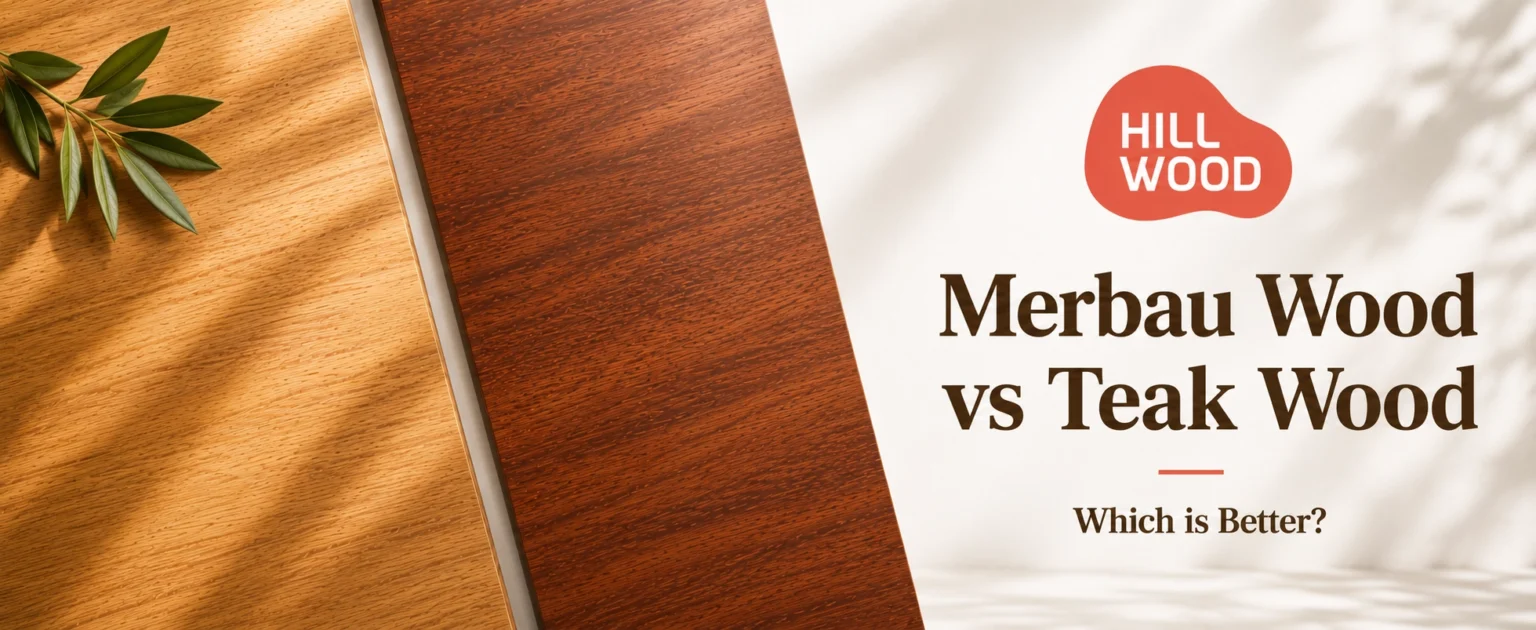
Merbau Wood vs Teak Wood — Which is Better?
Choosing the right wood for your home is one of the most important decisions you will make during construction or renovation. The wood you choose for your doors, flooring, and furniture determines how your home looks, how long it lasts, and how much you spend on repairs over the years.
Two names come up repeatedly in this conversation — Merbau and Teak. Both are premium hardwoods. Both are popular across India. And both are known for their strength and durability. But they are not the same material, and the right choice depends entirely on what you are building and where.
In this blog, we compare Merbau wood and Teak wood across the factors that matter most — durability, termite resistance, moisture performance, cost, and the best applications for each.
What is Merbau Wood?
Merbau is a tropical hardwood native to Southeast Asia and the Pacific islands, primarily sourced from Indonesia and Papua New Guinea. It has been used in construction for over a thousand years — from structural beams and bridges to canoes — because of its exceptional hardness and natural resistance to decay.
In India, Merbau has grown in popularity as a premium alternative to Teak. Its rich reddish-brown tone, dense grain, and natural oils make it one of the most durable hardwoods available in the market today.
Key characteristics of Merbau wood:
- Hardness: Extremely dense and hard, with a Janka rating of approximately 1,925 lbf
- Color: Yellowish-orange when freshly cut, deepening to a rich reddish-brown over time
- Natural oils: High oil and resin content provides built-in resistance to termites, moisture, and decay
- Lifespan: 50+ years when properly treated—making it one of the most cost-effective hardwoods over time. At Hillwood, our Merbau wood is sourced from 100-year-old Papua origin trees and chemically treated for maximum durability, backed by a 25-year warranty.
What is Teak Wood?
Teak is arguably the most well-known hardwood in India. Often called the “King of Woods,” it has been the benchmark for premium timber in the country for generations. Teak grows primarily in South and Southeast Asia, with Burma Teak and Nilambur Teak being the most sought-after varieties.
Its reputation is well-earned. Teak contains natural silica and oils that make it genuinely waterproof and highly resistant to termites — qualities that few other woods match naturally.
Key characteristics of Teak wood:
- Hardness: Dense but slightly softer than Merbau, with a Janka rating of approximately 1,155 lbf
- Color: Golden-brown when fresh, mellowing to a silver-grey if left untreated outdoors
- Natural oils: Very high natural oil content — repels water, rot, and termites without chemical treatment
- Lifespan: 50+ years with proper care; heritage-quality Teak furniture often lasts generations
Merbau vs Teak: Side-by-Side Comparison
| Feature | Merbau Wood | Teak Wood |
|---|---|---|
| Hardness | Very High (1,925 lbf) | High (1,155 lbf) |
| Termite Resistance | Very High (natural oils + treatment) | Very High (natural oils) |
| Moisture Resistance | Excellent | Excellent |
| Durability | 50 years+ | 50 years+ |
| Workability | Moderate (dense; needs sharp tools) | Easy to work with |
| Color | Rich reddish-brown | Golden-brown |
| Price in India | Moderate | Very High |
| Availability | Imported (Indonesia / Papua) | Imported + Domestic |
| Best For | Doors, windows, flooring, decking, staircases and structural purposes | Furniture, luxury doors, outdoor structures |
Which is Better for Doors and Window Frames?
This is where Merbau has a clear advantage for most Indian homeowners.
Doors and window frames face daily stress — constant opening and closing, temperature changes, and in coastal and humid regions, year-round moisture exposure. Merbau’s higher density means it is less likely to warp, crack, or expand under these conditions compared to Teak.
Its dimensional stability is exceptional. Even in regions with extreme humidity — like Kerala’s coastal belt or Bangalore’s variable climate — Merbau door frames maintain their shape over decades.
Teak is also an excellent choice for doors, particularly for carved or heritage-style entrances where its golden tone and workability allow for intricate detailing. However, premium Burma Teak for main doors can cost significantly more, making it less practical for large-scale residential projects.
Verdict for doors: Merbau is the more practical and cost-effective choice. Teak wins on aesthetics and carving flexibility.
Which is Better for Flooring?
For flooring, Merbau is the stronger performer in Indian conditions.
The higher Janka hardness rating means Merbau flooring resists scratches, dents, and heavy foot traffic better than Teak. In high-traffic areas like living rooms, hallways, and staircases, this matters enormously. A floor that holds its surface for 20 years instead of requiring refinishing after 10 is a meaningful difference in real terms.
Merbau flooring also handles humidity-driven expansion and contraction very well. The wood’s natural oils reduce moisture absorption, which prevents the gapping and cupping that commonly affects lower-quality flooring in Indian homes.
Teak flooring is beautiful and long-lasting, but its softer surface relative to Merbau means it shows wear faster in busy households. It remains a popular choice for bedrooms and low-traffic interiors where its warmth and colour are the priority.
Verdict for flooring: Merbau is the better choice for high-traffic areas. Teak works well for bedroom flooring and luxury low-traffic spaces.
Which is Better for Furniture?
Here, Teak has the traditional edge — and for good reason.
Teak’s ease of workability makes it the preferred choice for skilled craftsmen creating dining tables, beds, chairs, and cabinetry. It accepts polish, stain, and lacquer beautifully. Its golden hue under a natural finish is hard to match. And its heritage value in India means Teak furniture carries a premium resale value that no other wood currently replicates.
Merbau is increasingly used for heavy furniture, built-in wardrobes, shelving units, and feature panels. Its density means it holds screws and joints extremely well, making it structurally superior for large-format furniture pieces like custom wardrobes or built-in cabinetry.
If you are building statement dining tables or heirloom-quality bedroom sets, Teak remains the gold standard. For built-ins, modular cabinetry, and heavy structural furniture, Merbau is an excellent and more affordable alternative.
Verdict for furniture: Teak for premium standalone furniture. Merbau for built-ins, cabinetry, and heavy-use furniture.
Which is Better for Decking and Outdoor Structures?
Both woods perform well outdoors, but Merbau has a practical advantage.
Merbau is one of the world’s most widely used decking timbers — its natural oil content and density make it resistant to moisture, rot, and insect attack even without chemical treatment. When treated, as Hillwood’s Merbau is, the performance extends dramatically.
Teak is equally capable outdoors, but its significantly higher price point makes large-area decking or pergola projects far more expensive. For most homeowners building patios, garden decks, or balcony flooring, Merbau delivers equal or better performance at a considerably lower cost.
Verdict for decking: Merbau is the better value choice for outdoor applications. Teak is suitable when budget is not a constraint.
Merbau Wood Price vs Teak Wood Price in India
Cost is one of the most significant differences between these two woods in the Indian market.
Teak — particularly Burma Teak and Nilambur Teak — commands a premium price driven by its decades-long reputation, relative scarcity, and high domestic demand. It is consistently among the most expensive solid woods available in India.
Merbau is priced lower than premium Teak, while delivering comparable or superior performance in most structural and flooring applications. For projects that require large volumes — flooring across multiple rooms, door frames throughout a house, or full-building construction — the cost difference becomes significant.
It is worth noting that the true cost of wood is not just the purchase price. A wood that lasts more than 50 years without repair is far cheaper over time than one that requires replacement or refinishing within a decade. In this calculation, both Merbau and Teak — when properly treated — represent sound long-term investments compared to cheaper alternatives like plywood or MDF.
Pro Tip from Hillwood: Always ask your timber supplier whether the wood is kiln-dried and chemically treated. Untreated Merbau or Teak, even at a lower price, will not deliver the durability these species are capable of. Read more in our guide on Treated vs Untreated Wood.
Why Treated Merbau from Hillwood is the Smart Choice
Both Merbau and Teak are exceptional woods. The right choice depends on your project, your budget, and your priorities.
If you are building doors, flooring, staircases, and decking across a full home project in India, treated Merbau gives you the best balance of hardness, durability, moisture resistance, and value. If you are investing in a single statement piece of furniture or a heritage-style main entrance, Teak’s character and reputation justify the premium.
What matters more than the species is the quality of treatment. An untreated Merbau will not perform like a treated one. The same is true for Teak. Before buying timber, always verify that the wood has been kiln-dried, chemically treated, and sourced from a certified supplier.
At Hillwood, our treated Merbau and Mahogany hardwoods are processed at our own facility in Indonesia, kiln-dried to reduce shrinkage, and delivered ready-to-use — with a 25-year warranty that reflects our confidence in the material.
Frequently Asked Questions
- Is Merbau stronger than Teak? Yes. Merbau has a higher Janka hardness rating than Teak, making it denser and more resistant to dents and surface wear. For flooring and heavy structural use, Merbau is the stronger option.
- Which wood is better for the main door in India — Merbau or Teak? Both are excellent for main doors. Merbau offers better dimensional stability and is more cost-effective for large door and frame projects. Teak is preferred when elaborate carving or a golden natural finish is the priority.
- Is Merbau termite-resistant? Yes. Merbau contains natural oils and resins that repel termites and borer insects. When chemically treated, as Hillwood’s Merbau is, termite resistance is significantly enhanced for decades of protection.
- How long does Merbau wood last? Properly treated Merbau can last 50 years or more, making it one of the most cost-effective hardwood choices over time. Hillwood’s treated Merbau comes with a 25-year warranty.
- Is Merbau more affordable than Teak? Generally, yes. Merbau is priced lower than premium Teak varieties like Burma Teak or Nilambur Teak, while offering comparable or superior performance in most structural and flooring applications.
Conclusion
Merbau and Teak are both exceptional hardwoods — and choosing between them is not about which is universally better, but which is better for your specific project.
For most Indian homeowners and builders looking for durable doors, long-lasting flooring, and reliable structural timber at a sensible price, treated Merbau is the stronger choice. For premium standalone furniture and heritage-style aesthetics, Teak remains unmatched.
Whatever you choose, the quality of treatment and sourcing makes all the difference. Hillwood has been delivering certified, treated hardwood to builders and homeowners across India for decades. Contact us to find the right wood for your next project.